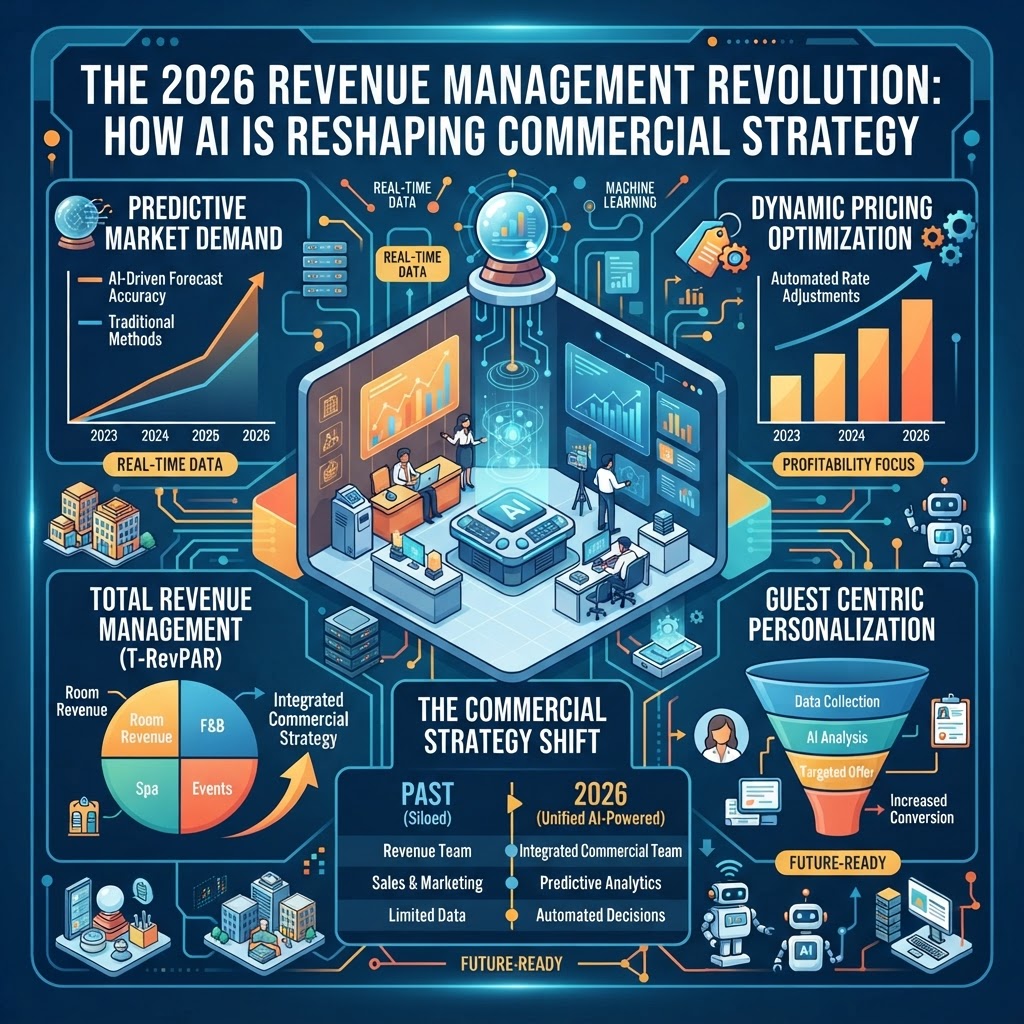
The 2026 Revenue Management Revolution: How AI is Reshaping Commercial Strategy
In the landscape of 2026, Revenue Management is no longer about manual pricing adjustments based on historical data. With the rise of Generative AI and deep learning models, hotels are shifting from traditional revenue management to comprehensive commercial management. According to STR, the ability to process real-time data is vital to maintaining a competitive advantage in a volatile environment.
AI and the Leap in Demand Forecasting
2026 marks the moment when AI-integrated Revenue Management systems do more than forecast volume; they decode behavior. Algorithms now analyze unstructured data from social media, search trends, and macro-events to predict lodging demand with extreme precision. Comparing revenue management tools in 2026 reveals that entities slow to adopt this technology are losing significant margins.
Hyper-personalization at Scale
Beyond simple pricing, AI allows hotels to offer Dynamic Bundling. Instead of a flat rate, systems automatically propose offers based on individual preferences and Customer Lifetime Value (CLV). This is a stark departure from legacy methods. To keep up with this trend, investing in revenue management training for staff has become more urgent than ever.
Challenges and Risks
Over-reliance on automation can lead to 'flat price curves' without human oversight. HospitalityNet has warned about the risk of losing business intuition when managers rely solely on AI. Understanding common mistakes in distribution strategy is crucial to avoid severe system errors.
Conclusion and Outlook
Revenue Management in 2026 is the synergy between AI's computational power and human decision-making sophistication. To succeed, managers must be agile, continue learning, and apply technology strategically. According to Skift, the future of the industry depends on how we leverage technology to enhance guest experiences rather than merely maximizing short-term profit.